The Law That Built the Internet at 30
By Colin Crowell, Managing Director, Blue Owl Group
Thirty years after the Telecommunications Act of 1996, can the U.S. Congress still legislate at that scale for artificial intelligence?
February 8, 1996. I can still recall the buzz in the ornate, circular reading room in the Library of Congress that February morning. In front of hundreds of elected officials, congressional staff, and corporate, labor, and civil society stakeholders, President Bill Clinton was about to sign the most consequential technology law in six decades. My boss, then-Representative, now Senator Ed Markey (D-MA) told me and a handful of other current and former staffers to station ourselves after the ceremony near a particular exit, where we hoped to catch a photograph with the President and Vice President Gore.
We had earned the right to relish the moment. Over multiple Congresses and countless late nights during House-Senate conference committee deliberations, we had successfully negotiated what would become the Telecommunications Act of 1996 (“Telecomm Act”). The law passed the House 414-16 and was approved in the Senate 91-5, an overwhelmingly bipartisan tally that seems almost mythical today.
The signing ceremony was the culmination of countless hearings, debates, markups and votes. At stake throughout the process was the creation of a public policy framework for our digital future and the nascent Internet, a place most Americans had yet to venture. And what ultimately made the effort successful, as was the case with other major tech laws of the ‘90s, was the bipartisan buy-in achieved during an era of divided government. The historic signing ceremony came only after tough but civil and civic-minded negotiations to secure bipartisan agreement.
When President Clinton finally emerged from the signing ceremony and paused for our photo, he and Representative Markey held together what the President called the "digital signing pen.” Clinton used that stylus to sign the bill electronically and transmit it over the Internet. It was the first law simultaneously signed with a traditional pen on parchment and digitally on a computer screen, a symbolic gesture meant to capture the law's essence. That digital presidential signature had opened the door to a future that none of us could fully imagine. And the President had gifted that historic digital pen to Markey, in recognition of his effective and successful leadership on tech issues over many years.
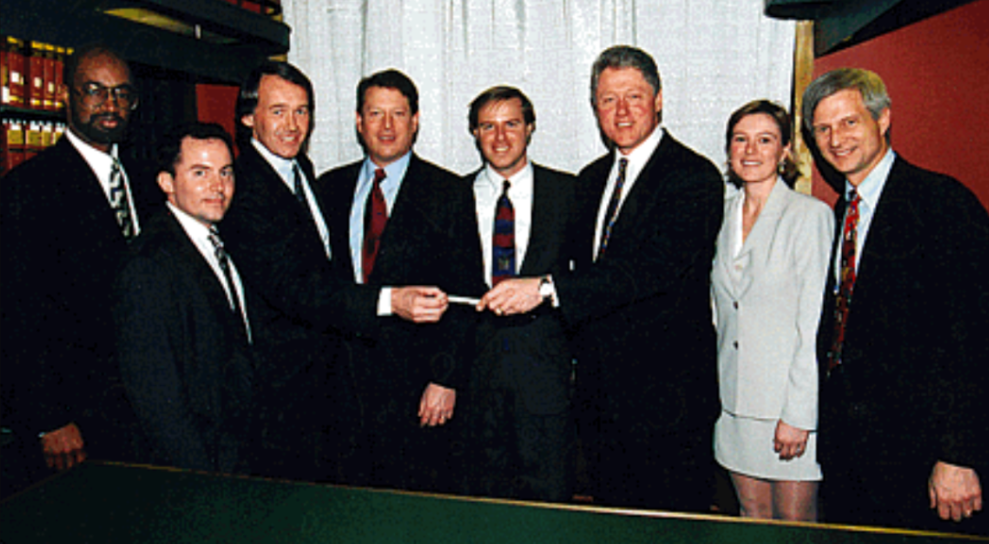
With the “digital signing pen” — from left to right, Larry Irving, Kevin Joseph, then-Rep. Ed Markey, Vice President Gore, Colin Crowell, President Clinton, Kristan Van Hook, and David Moulton
A Decade of Sweeping Technology Legislation
The 1990s was the decade of enormously consequential legislative achievements for technology policy. By the beginning of the decade, it was clear that the monopoly structure of U.S. telecommunications markets was holding emerging digital technologies hostage. Cable companies, local phone companies, long-distance carriers, and broadcasters all operated in separate regulatory silos. New digital technologies and the advent of the Internet were buffeting existing regulatory structures.
It was a period when, through a series of laws, Congress proceeded to systematically dismantle monopolies and built the foundation for the Internet era. These weren't isolated technical fixes. They were conscious decisions to crack open monopolistic markets and unleash competition, investment, and innovation on an unprecedented scale.
In 1992, Congress passed the Scientific and Advanced Technology Act, which amended the National Science Foundation's 'acceptable use policy' for NSFnet to allow commercial traffic on the Internet. This single policy change transformed the Internet from a government-funded research network into the commercial platform that now underpins the global economy.
That same year, Markey led an effort in the House to enact the Cable Act with sufficient bipartisan support to override President George H.W. Bush's veto. That law addressed skyrocketing cable rates and introduced new digital satellite competitors to incumbent cable TV providers. The law also had the effect of spurring cable companies to upgrade their facilities to digital technology, positioning them a few years later to deploy cable modems for Internet access to compete with broadband-deploying telephone companies. Markey would later work to include a provision into the competitive core of the Telecomm Act that barred local telephone and cable companies from merging, ensuring local competition between the two wires going down almost every street in America.
In 1993, as part of the "peace dividend" from the fall of the Soviet Union, Congress reallocated military spectrum for commercial wireless use and authorized auctions of new wireless licenses through a major budget bill. This sparked the mobile revolution that would put smartphones in tens of millions of pockets by the end of the decade and laid the foundations for the mobile app economy.
In 1998, Congress passed two landmark laws addressing emerging digital challenges. The Children's Online Privacy Protection Act (COPPA), for which Markey was the lead House sponsor, established the first federal protections for children's privacy online, requiring parental consent before websites could collect personal information from children 12 and under. This law represented early recognition that the Internet's data-gathering capabilities posed unique risks to youth and set a precedent for digital privacy protections that would influence similar laws adopted internationally and policy debates on privacy protections for those over 12 years of age for decades to come.
Enacted that same year, the Digital Millennium Copyright Act (DMCA) sought to balance effective copyright protection in the digital age with the need to allow fair use of such content to drive ongoing innovation and creativity. This was a balanced compromise that created greater certainty in the marketplace for digital content and would enable platforms like YouTube, Instagram, Vimeo, Spotify, Dropbox, and Google to grow their services while giving content creators new tools to protect their work online.
It's important to note that every single one of these bills was overwhelmingly bipartisan, and all of them, with the exception of the spectrum auction law in 1993, came during a period of divided government, with the President of one political party and the Congress in control of the other. In addition to then-Representative Markey (D-MA), the Telecommunications Act was championed by a diverse group of both Republican and Democratic legislative leaders, including Senators Fritz Hollings (D-SC), Larry Pressler (R-SD), Olympia Snowe (R-ME), John Danforth (R-MO), Dan Inouye (D-HI), Ted Stevens (R-AK), and Trent Lott (R-MS), along with Representatives Tom Bliley (R-VA), John Dingell (D-MI), Jack Fields (R-TX), Rick White (R-WA), and Anna Eshoo (D-CA).
And at the center of all the 90s-era lawmaking was the multiyear effort to pass the Telecomm Act.
The Telecomm Act included two provisions that would prove especially consequential. The E-Rate program, for which Markey was the lead House sponsor, provided subsidies to connect K-12 schools and public libraries to the Internet, directly addressing what he cited as the risk of a growing “digital divide” between those with access to technology and those without. Over time, the E-Rate would become the largest education technology program in the federal government, with annual funding in the billions. It serves as a great equalizer in American society by providing access to the Internet for millions of kids in schools and for everyone at local public libraries. For more legislative history on the E-rate provision, see this piece I wrote about the E-rate for the 25th anniversary of the Telecomm Act here.
The second major provision is now often simply referred to as “Section 230.” This provision passed as part of the Telecomm Act safeguards free expression on the Internet by protecting online platforms and people using such services from liability for user-generated content. Section 230 emerged from a policy collision between speech and new technology and was adopted into the Telecomm Act to specifically address adverse court decisions. In 1995, the courts had issued rulings that turned tech policy on its head, putting companies that moderated content on their services in legal jeopardy while rewarding those who embraced a wild, wild west ethos and turned a blind eye to harmful content. Section 230 became a legal foundation for the modern Internet ecosystem and spurred the growth of the U.S. tech sector globally. Although it remains one of the most politically misunderstood provisions in modern American law, it protects important constitutional rights for both Internet services and the people who use them. For more legislative history on Section 230, see this piece I wrote on Section 230 for the 25th anniversary of the Telecomm Act.
Bipartisan Process Under Pressure
The effort to pass the Telecommunications Act unleashed one of the most heavily lobbied efforts Congress had ever seen, with billions of dollars in market share at stake.
When I first started working for Chairman Markey on the Telecommunications Subcommittee in 1989, he had already tasked his staff to develop drafts of bills and hold hearings on the various cutting-edge issues that needed to be addressed to overhaul the nation’s tech policy framework. Even then, the lobbying was already intense and the pressure would never stop. The Bell telephone companies, long-distance carriers, cable giants, radio and television broadcasters, organized labor, public interest and civil society groups, computer companies, consumer electronics manufacturers, wireless service providers, movie studios, record labels — almost everyone had a stake in the outcome of our deliberations. And the lobbying spending by the tech behemoths of the time was off the charts. Whether bipartisanship and the ability to strike enduring compromises to advance the interests of the country would survive the heavily-lobbied legislative process was another question entirely.
But here is what people miss when they imagine the 1990s as some golden legislative age — it was still partisan. But it was more functional. Disagreements were real but the discourse was more civil. The incentives were different. And most importantly, relationships across party lines, including genuine friendships amongst lawmakers and especially among staff, were more commonplace and facilitated legislative progress.
When Republicans took control of Congress after the 1994 elections, Markey lost the Subcommittee gavel. Yet even then, personal respect and open channels persisted. Longstanding relationships with incoming Chairman Tom Bliley (R-VA) and Subcommittee Chairman Jack Fields (R-TX) meant that lines of communication remained open. Shortly after the ’94 election, Senator Larry Pressler, now incoming chair of the Senate Commerce Committee, invited Markey to lunch to ask for his advice and to learn how Markey had moved the prior year's bill successfully through the House and what principles and compromises made it possible. The same openness to bipartisanship and longstanding personal relationships, especially on the Committee level, was prevalent in the Senate Commerce Committee with Senators Hollings (D-SC), Inouye (D-HI), and Stevens (R-AK,) for example.
That kind of personal, bipartisan interaction helped keep legislative prospects alive. Because Markey had conducted consideration of tech policy bills in the Subcommittee the previous session in a bipartisan way, that formed a foundational basis for moving forward on key provisions in the next Congress, despite new policy differences around media ownership rules and cable competition, which required additional debate and negotiations.
And sometimes the era's odd mix of conflict and comity produced moments of levity. When Newt Gingrich, then the Republican House Minority Leader, praised the bipartisan Markey-Fields bill on the House floor in the previous congressional session in 1994 as a model of genuinely bipartisan legislative process, Markey turned to his lead counsel Gerry Waldron and me and half-jokingly asked what on earth was in the bill. But beyond the substance of the bill, it underscored a mode of bipartisan engagement which is now increasingly rare. In other words, the process itself reflected a bipartisan approach from the start, a mode of operating legislatively that included continuous consultation, close staff collaboration, and sufficient trust between elected officials.
The Law's Transformative Impact & Lessons for AI
It's sometimes difficult to recall how the early Internet felt in 1996. The overwhelming majority of Americans weren't online. Residential broadband didn't exist and Internet access was dial-up, as broadband service would not become a mass-market reality until after the Telecomm Act passed.
The apprehension and excitement surrounding the early Internet mirrors today's debate about artificial intelligence. In the mid-90s, skeptics questioned whether anyone would actually make money on the World Wide Web, while workers worried whether new technology would enhance their productivity or eliminate their jobs entirely. Those same questions echo loudly today as generative AI transforms industries and work itself. Just as the Internet required foundational policy decisions about access and liability, AI now demands similar frameworks around safety, transparency, and accountability. The challenge then, as now, is to enable innovation while working hard to ensure that emerging technology serves broad societal benefits, rather than entrenching new divides.
The 90s demonstrated that Congress could still rise to historic responsibility to address transformative technology when it worked its will through bipartisan negotiation and concrete action. The law Congress crafted three decades ago helped unleash the Internet age, sparking innovation, enabling consumer choice, connecting the nation’s schools and libraries (through the E-Rate program), breaking up entrenched telecommunications monopolies, and establishing the essential liability protections (through “Section 230”) that would enable Internet services like Wikipedia, LinkedIn, Facebook, Twitter, and countless other similar services to exist and thrive.
The Telecomm Act also unleashed massive investment and job creation. Broadband service, which had been delayed in its deployment because of the monopoly structure of U.S. telecommunications markets, witnessed a surge of new capital investment as competition accelerated infrastructure spending in the law’s aftermath. Over time, this enhanced infrastructure would foster even greater innovation and marketplace changes. Netflix, for example, was eventually able to transition from a service that mailed you your DVD movies into a streaming service because the broadband infrastructure investments sparked by the Telecomm Act made the transition possible.
Yet as we look back with the advantage of time, the Telecomm Act had a few deficiencies. First, while Markey had proposed a provision in the House version of the Telecomm Act that we referred to as a “privacy bill of rights,” that language was stripped out of the bill in the House-Senate conference. The inability of Congress in subsequent years to pass a comprehensive federal privacy law governing data privacy would mean that tech platforms like Facebook, TikTok, Instagram, and others could readily harness personal data to drive user growth and advertising revenue. The personal data gleaned from people’s use of online services also provides the fuel for algorithmic processes that increasingly yield problematic results, such as abuse, harassment, disinformation, foreign information operations, and manipulated media.
Second, while the law successfully unleashed competition and broke down legal separations in the marketplace, the new law did not address reforming the governance frameworks to oversee policy development and the policing of the emerging digital sector. Those pre-existing regulatory and policy frameworks were built prior to consideration of the Telecomm Act, when industries were in regulatory siloes. They remain largely stuck in time even today. The result is that existing digital governance structures in the U.S. struggle to contain the technologies they were meant to govern. The U.S. still has no centralized entity that establishes national digital policy and no effective digital regulator. What we have is an orchestra without a conductor, where an acronym-rich ensemble of multiple agencies — FTC, FCC, DoJ, NTIA, NIST as well as various entities within the White House itself (NSC, NEC, DPC, OSTP) — all play from different scores, leaving both the public and industry struggling to discern the melody.
Finally, as we mark the 30th anniversary of the Telecommunications Act of 1996, I find myself reflecting not just on what lawmakers got right or wrong, but on a more fundamental question: Can the United States government still legislate effectively for transformative technologies? And if so, what can the story of the Telecomm Act teach us about how to do it, especially as we confront the myriad policy issues posed by artificial intelligence?
The AI Challenge: Can Congress Legislate at Scale Again?
Today, three decades after President Clinton and then-Representative, now Senator Ed Markey stood together in the Library of Congress with that digital signing pen, symbolically opening a door to a future none of us could fully imagine, Congress confronts a new threshold with artificial intelligence. AI will have profound impacts, both positive and negative. Public policy’s aim should be to maximize the former and limit the latter. AI can accelerate discovery and improve efficiency, service delivery, and productivity, but AI will also enable new vectors for fraud, disinformation, surveillance, and concentration of power.
The question people in Washington and in capitals overseas keep asking me is: Can the U.S. Congress do for AI what it did for the Internet? Or will Washington cede tech policy leadership to the 50 States, or to Brussels, Brasilia, Delhi, or Canberra?
My gut tells me that the answer to that question is that Congress may be able to do so, but only if it rediscovers what made the Telecomm Act possible. Changing the toxically partisan political dynamic in Washington, D.C. is a highly daunting prospect in the current political climate. Indeed, it may be a bigger lift than passing any single bill.
AI is not a niche technology in need of a narrow fix. Like the Internet in the early 1990s, it is becoming a general-purpose layer that will run through education, health care, media, national security, the energy sector, and the economy generally. In that sense, it demands an equivalent to the series of laws that were put on the books for the Internet in the 90s. It needs an overarching policy framework that encourages innovation and competition, while embedding public interest obligations and common sense safeguards.
Today's politics are clearly more poisoned. As a result, many policymakers think small rather than dreaming big. Simply pre-empting state authority on AI is cast by some as if that action in itself would be a major policy achievement, rather than simply the byproduct of forging and adopting a national policy framework. In recent years, Congress seems only able to address public policy issues when it considers “must-pass” spending measures, which often limit or bar consideration of policy issues unrelated to spending.
Current day politics are also more performative, more corporate-driven, and more suspicious of good-faith compromise than the politics lawmakers navigated in the 1990s. The same tools that powered bipartisan cooperation then, namely extensive hearings, patient committee work, staff-level trust, House-Senate conference negotiations, and elected officials willing to subordinate partisanship to national interest, are much weaker now.
And yet, I don't think bipartisanship is fully gone. At least I pray it isn’t. Bipartisanship is certainly more fragile, more easily derailed, and more dependent on whether short-term political incentives align. My view is that there is a chance that AI could align them. First because the political parties have not yet established a party line orthodoxy to many discrete and novel AI issues, and second, because AI involves areas where the prospects for bipartisanship remain strong. In other words, AI policy affects national economic competitiveness and national security — traditional terrain for strong bipartisanship — as much as it impacts culture, speech, education, health, energy, climate, and workforce issues.
The stakes are no less significant than they were in 1996. Thirty years ago, we tried to write rules for a future we could only glimpse. Then, we were building the on-ramps to the "information superhighway." Now, we're deciding who controls the infrastructure of intelligence itself. Once again, we are confronted with policy choices to determine whether technological innovation serves democratic values or concentrates power in ways that undermine them.
This time, Congress must avoid the mistakes of the past. Privacy protections cannot be kicked down the road again. They must be embedded from the start, before harmful patterns become entrenched. Equally important, policymakers must address governance structures alongside substantive policy issues. Rather than perpetuating the fragmented, New Deal-era framework we left largely unchanged in 1996, we need a coherent national entity with clear authority over AI policy - an effective AI “cop on the beat.” Without this, we risk repeating the coordination and enforcement failures that have undermined digital governance for decades.
The 1990s teach us that landmark tech policy is possible to achieve when leaders treat technology not as a talking point, but as infrastructure for democracy and national opportunity. National policymakers have a chance to learn the lessons of 90s-era legislating for the early Internet, but the window to provide much-needed leadership and secure bipartisan buy-in for the AI era is rapidly closing. America can't hope to win the AI race technologically if it loses the moment to build the national policy framework for its enduring success.
The AI era will not wait for Washington to feel ready.