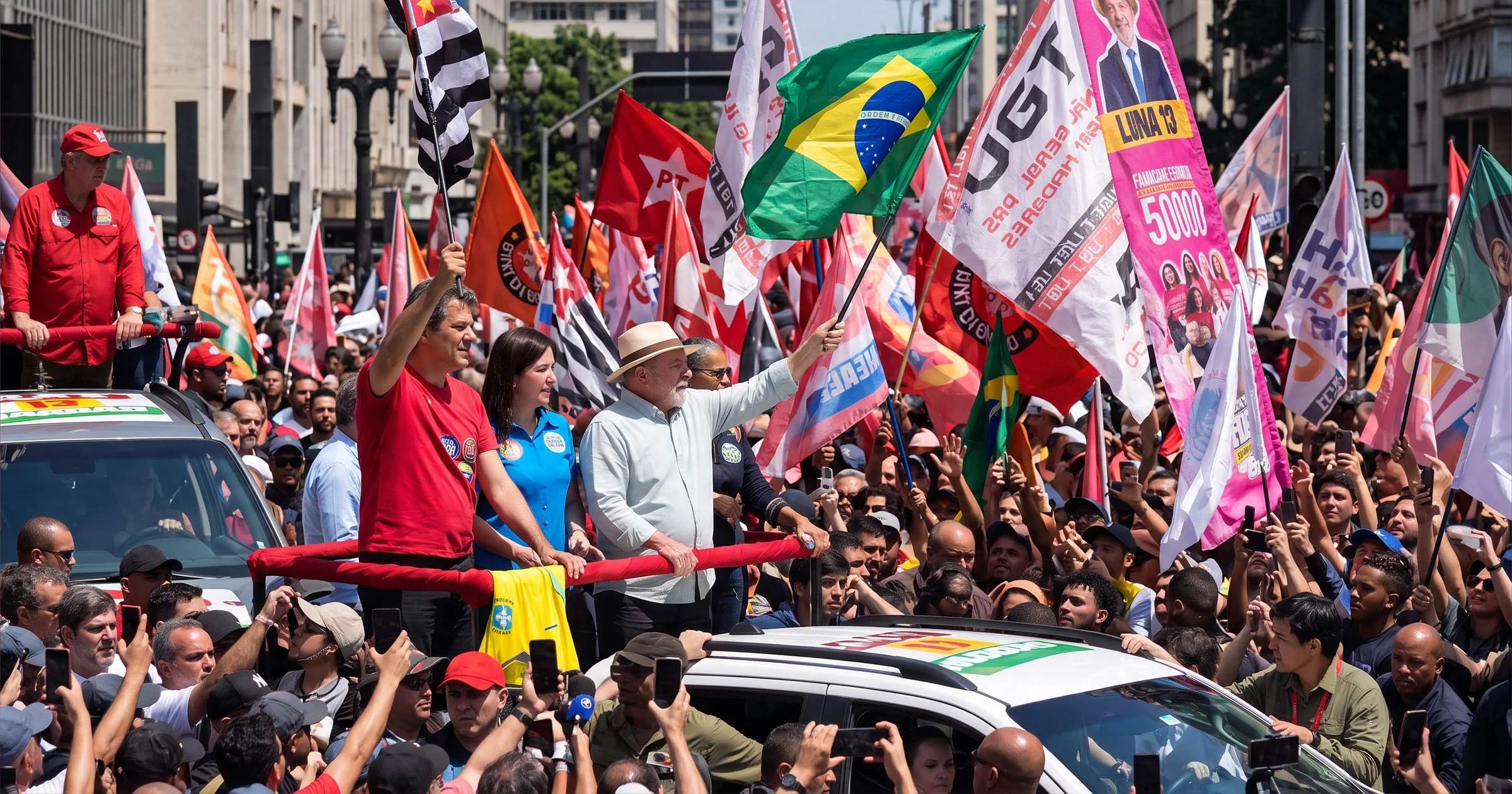
Brazil’s President Lula recently won a historic victory, securing re-election and a fourth term. After coming in second in the first round of voting, Lula engineered a comeback without precedent since Brazil’s return to democracy. His opponent, Flávio Bolsonaro, shocked the country by fleeing to the United States two days after the vote, defying a Supreme Court order to surrender his passport.
The runoff results come on top of a first round that went the other way and that will have implications for the Brazilian Congress. The Liberal Party (PL), the Bolsonaro family’s party, won the largest caucuses in both the Chamber of Deputies and the Senate, 121 of 513 deputies and 28 of 81 senators, the biggest delegations any party has held since the 1988 Constitution.
These two dynamics are key to understanding Brazil’s political future and how the shift in Brazil’s political balance of power will directly shape the digital policy agenda.
A leadership vacuum on the right
Shortly after arriving in the U.S., Flávio released a letter to the Brazilian people in which he called himself the “true president-elect” of Brazil. Minutes later, he replaced the phrase with “leader” of the nation. Brazilian media report that he did so under pressure from the Trump administration. President Trump called the election “a disgrace” but said he would not get involved, and U.S. diplomats advised Flávio to keep a low profile.
His departure left a leadership vacuum on the right and far right. The Bolsonaro family still commands strong support, but Flávio’s departure has left many on the right feeling betrayed and abandoned. The key question now is whether the Bolsonaro family will retain that leadership or whether other players will step in. Cracks in the family’s standing, and attempts by rivals to claim at least part of the movement’s leadership, cannot be ruled out.
Former president Jair Bolsonaro remains under house arrest. Just as he chose Flávio as his candidate, he could now back his wife, Michelle, who was elected senator, alongside another son, Carlos. Jair Bolsonaro’s youngest son, Jair Renan, was elected federal deputy. The two sons are seen as politically weak, but his wife has popular appeal and could emerge as a viable option.
Congressional leadership races

Meanwhile, as the right and far right were trying to figure out what came next, the newly re-elected President Lula met with the current Speaker of the Chamber of Deputies and the President of the Senate and endorsed both for re-election.
The Speaker is all but assured another term, but the Senate race is highly uncertain. The Bolsonaros’ party will control 28 of 81 seats and the party also elected allies in other parties. The race is expected to be tight, and its outcome will determine whether Lula can advance his agenda and appoint members to federal agencies, and whether Supreme Court justices could face impeachment.
Implications for tech policy
The Lula administration emerges from the election determined to push for more digital regulation and to confront the corporate power of Big Tech, particularly after his campaign accused Meta of using its platform to tilt the race toward Bolsonaro, a charge Meta denies. Platform regulation took center stage in Lula’s victory speech. The President accused big tech companies, Meta in particular, of election interference and criticized their power to meddle in politics. This issue had never featured so prominently in a presidential address of this magnitude.
Lula’s victory removes the prospect of a swift dismantling of the regulatory architecture built over recent years, a possibility that arose in the first round, with an even more right-leaning Congress-elect. Even if continuity in government doesn’t make it easier to pass new laws through Congress, it ensures a path forward for implementing existing rules and continuity in the secondary regulatory framework, with disputes playing out in enforcement proceedings, administrative decisions, and judicial interpretations.
The tone of the President’s speech and the course of the campaign, however, point to a reframing. Between 2020 and 2026, platform regulation was built primarily around disinformation, hate speech, and other online harms. Now, the campaign experience has brought back a broader debate, especially on the left, about Big Tech’s corporate power over how information flows and how users participate in the digital space.
In this new landscape, recommender systems, algorithmic content distribution, information asymmetries between platforms and users, due process in content moderation, and transparency mechanisms are gaining greater weight.
The incidents involving Meta during the election could also affect the progress of the Artificial Intelligence Bill (PL 2338). From the start, the bill has been heavily focused on protecting rights, to the point of being considered more restrictive than the European AI Act; now, pressure to take on Big Tech’s corporate power could force changes in that direction.
For the same election-driven reasons, the Digital Markets Bill (PL 4675), Brazil’s version of the European Digital Markets Act, is also expected to gain momentum, becoming another avenue through which the government will try to take on Big Tech’s power.
Digital infrastructure and technological sovereignty
Other digital policy issues also came up in the President’s speech. Lula said that in his fourth term he intends to expand investment in the digital economy, attract data centers, and develop a Brazilian AI. The plan is to leverage the country’s renewable energy potential (roughly 90% of Brazil’s electricity comes from renewables) to attract tech companies and expand national data storage and processing infrastructure. He also promoted homegrown technology to reduce dependence on foreign solutions, especially from U.S. and Chinese companies.
Also on the infrastructure front is the issue of rare earths, whose implementing regulations are still pending. This year, the government successfully steered a law on the subject through Congress, covering a sector where the country carries real weight: Brazil holds roughly 25% of global rare earth reserves, second only to China, yet accounts for less than 1% of industrialized products derived from them. The law lets companies claim tax credits and creates a council under the Presidency with authority to approve changes of corporate control and international supply contracts. The real test, however, is regulation. Geopolitically, Lula has signaled a policy of conditional openness, one in which he welcomes partners, including the U.S., provided sovereignty is preserved and technology is transferred.
Outlook
Once again, Lula’s ability to deliver on this agenda depends largely on the outcome of the Senate leadership election on February 1.
The political realignment triggered by Flávio’s departure will likely have an effect during the final months of the current terms, from November through January. During this window, vacancies at agencies that regulate platforms may be filled, and another Supreme Court justice may be confirmed, both of which would shift the balance of power. The window is short, however, and much of the agenda may carry over to the next legislature, where the Senate outcome will be decisive.